



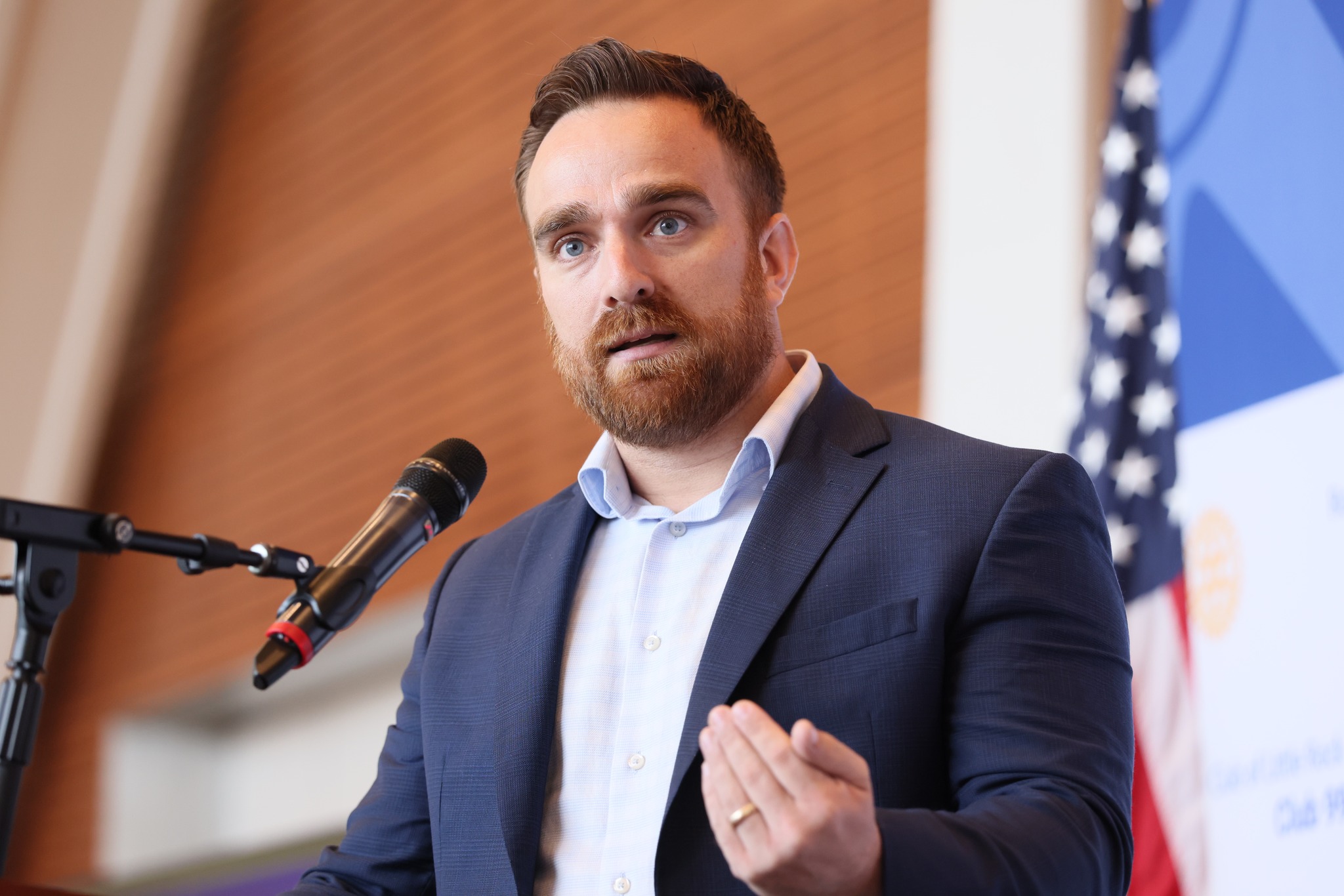
Slade Hickmon, Capstone CEO
Rotary Club of Little Rock
For more than two decades, Capstone Treatment Center has worked with young men ages 14 to 28 who have been described by their loved ones as failing to launch into adulthood.
- They aren’t working.
- They aren’t driving.
- They aren’t forming relationships.
In many cases, they aren’t even leaving the house. The common assumption is that something is wrong with them. At Capstone, we don’t believe that’s true.
After serving roughly 2,300 families from 49 states over 24 years, what we see over and over again is one of the greatest cultural changes that’s happened in history – the idea of failure to launch. But in reality, it is a failure to connect. And that difference matters enormously, because it changes everything about how we treat it.
We Have Been Treating Eruptions, Not Causes
Parents are not wrong about what they are seeing in their kids. The behaviors are real. The struggles are real. But schools, doctors, treatment programs and parents themselves have too often focused on the eruptions, the behavioral and mental health symptoms that rise to the surface; without asking a more fundamental question: what makes this make sense?
That question is simple, but the willingness to sit with it long enough to get an honest answer is rare. When we do sit with it, the answer is almost always the same regardless of geography, background or family structure. Connections are the problem.
Young people are losing connection to their parents. They are losing connection to purpose. And because so much of who we are is built during our formative years, the result is adults — sometimes 25, sometimes 35 years old — who are still searching for something they were supposed to find much earlier.
A Digital Village
There is a moment that captures this shift clearly. Picture a youth sports game, a band recital, a dance performance. A child looks up from the field or the stage to find a parent in the crowd.
A generation ago, that parent was looking back. There was eye contact. There was a presence. Biology does something specific in that moment, something that connects a child to their network of growth in a way that words cannot replicate.
Now, in that same moment, the child sees a phone. The phone receives more eye contact, more physical attention, and more consistent engagement than the child does. Parents did not set out to become producers instead of fans. Most of them are recording and sharing because they love their kids and want family members to feel included.
But the village was never meant to be a digital one.
That shift, repeated across thousands of ordinary moments, has quietly eroded something critical. Children have grown up in homes where a device receives more reliable attention than they did. And then we wonder why, as young adults, they struggle to connect.
What We Have Taken Away
There is another piece of this that is harder to talk about because it runs against the instincts of every parent who loves their child: we have removed the dragons.
Young men, in particular, need something to chase. They need challenges. They need to experience the specific kind of growth that only comes from hard things. The generation that flew at Kitty Hawk and landed on the moon was shaped by depression, by world wars, by a world that did not make things easy. Hard times-built people who were capable of extraordinary things.
What we have built instead is a generation with access to everything and the drive to pursue almost nothing. We now regularly work with 18- and 23-year-olds who have never had a driver’s license. Not because they live in cities with public transit. These are young men all across the country. The desire to have a car, which once felt like an unstoppable force in adolescence, has simply dissolved for many of them.
Boredom created drive. Boredom is where a kid decided to go outside, join something, build something, chase something. We have eliminated boredom through constant scrolling, and in doing so, we have eliminated one of the most important engines of human development.
What Connection-Based Treatment Looks Like
At Capstone, the treatment model is built around rebuilding what was lost. Every client receives an AKC registered Labrador that they keep when they leave. This connection upon arrival has had a powerful impact for our young men. Therapist caseloads are capped at two clients each, because genuine connection cannot happen at scale. Family integration is woven throughout the 90-day program, because the family system itself usually needs healing alongside the individual.
The goal is not to suppress the eruptions. The goal is to get to the root cause of their pain and rebuild the relational foundation that was supposed to be there from the beginning.
It is also why we fight harder with families about phones than we do about almost anything else. Parents will often negotiate hard to allow their son to have a cell phone immediately after treatment. Our answer is almost always: he is not ready. He could access everything he was struggling with through that device. The recovery plan must include a plan for the phone, or the device can be the quickest way to backtrack progress that has been made.
The Harder Truth
The most difficult conversation we have with parents is not about their child. It is about what they are willing to stop doing.
Parents who come to Capstone have often experienced multiple treatment stays are pushing hard to help their child. Their most consistent question is: how do I make this easier for them?
The answer is: don’t.
The harder things are at a younger age, the more capable a person will be as an adult. Lowering bars, removing consequences, and softening the path does not protect young people. It delays their development and makes the eventual reckoning far worse.
Young adults need to experience accountability; they need to get a job and possibly get fired from that job, or at the very least be held to a standard expectation. The more experiences over time, in the real world, will build a person that can function as an adult.
Common sense, it turns out, is no longer common. It has to be taught, practiced, and earned. And that process requires connection, consequences and the willingness to let hard things be hard.
How Capstone Treatment Center Meets The Needs
At Capstone Treatment Center, each client receives extensive hours of individual and group therapy every week, far exceeding industry standards. Our therapists carry the smallest caseload in the country (2:1), allowing them to stay deeply connected with each client and their family throughout treatment. Our team is trained in our proven Core Systems Model created by Dr. Adrian Hickmon, trauma, attachment, family systems work, Certified sex addiction, IFS-informed, EMDR, BSP, Safe & Sound Protocol, and more, ensuring that healing happens not just for the individual, but within the family as a whole.
Families choose Capstone because we provide clinical depth, we are Family-owned and family focused, our Christ-Centered team puts the client first, and our clinical expertise provides the connection needed for real and lasting change.